
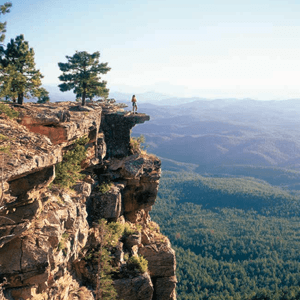
The Mogollon Monster is Arizona’s best known Bigfoot type legend. It is said to inhabit the heavily forested country around the Mogollon Rim, a huge escarpment running roughly 200 miles across central Arizona. Reports typically describe a large, humanlike creature often 6–8 feet tall with long dark, reddish, or gray hair, a relatively hairless face, enormous arms, and a powerful odor. Other recurring details include deep footprints, strange screams or whistles, rock throwing, and an ability to move surprisingly quietly.
The 1903 I.W. Stevens encounter
The earliest documented newspaper account generally associated with the Mogollon Monster dates to 1903, when I.W. Stevens described an encounter published in The Arizona Republican. The Library of Congress has also identified this newspaper account as the earliest known written report of the creature.
Stevens called what he encountered a “wild man of the rocks.” His description was unusually dramatic: he reported a naked, humanlike figure covered largely in gray hair, with long white hair and a matted beard reaching toward its knees. He also claimed that its fingers ended in long, clawlike nails.
According to Stevens, he came upon the creature feeding on two young cougars. When it realized he was watching, it allegedly threatened him with a large club and produced an extraordinarily loud, frightening scream. Stevens fled.
There is an interesting wrinkle here: the 1903 newspaper account doesn’t necessarily call the creature the “Mogollon Monster.” The modern name developed later. Arizona Highways notes that the creature apparently did not appear under that name in newspapers until a 1967 article about a Boy Scout camping trip.
The Don Davis Boy Scout encounter 1940s
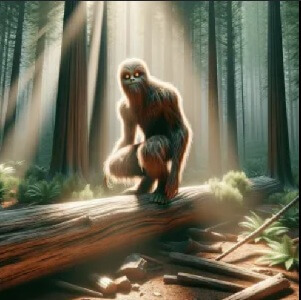
One of the most famous later accounts comes from Don Davis, who eventually became involved in cryptozoology. Davis said that as a teenager he was camping with Boy Scouts near Tonto Creek outside Payson in the early to mid 1940s.
While hiking with another boy, Davis reportedly saw a reddish-brown, humanlike figure moving through the forest with an unusual rocking gait. Later that night, something disturbed the campsite. Davis reported seeing a huge, hairy humanoid close to his sleeping area.
His description included:
a massive chest, shoulders, and arms
a square-looking head and jaw
deep-set eyes
hair covering much of the body but apparently not the face
an extremely strong, unpleasant odor
The creature reportedly remained around the camp for a time before disappearing into the woods.
This story became particularly influential because it fits many characteristics later associated with Bigfoot reports throughout North America: a large biped, nocturnal activity, unusual odor, close-range observation, and unexplained sounds.
White Mountains / Fort Apache reports
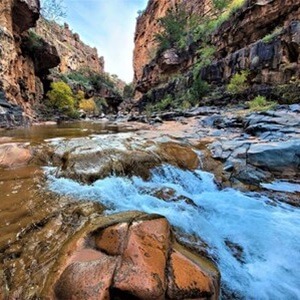
There have also been reports from the White Mountains and the Fort Apache area. These are particularly interesting because they come from people living in or familiar with the region rather than solely from tourists passing through.
One frequently cited witness is Marjorie Grimes, who said she encountered a tall, black, humanlike figure while driving near Whiteriver. She reportedly stopped, backed up to get another look, and found that the figure had disappeared.
Reports from the area have also included claims that the creature was seen around homes or looking through windows. A tribal police officer, Ray Burnette, was quoted discussing calls from frightened residents who believed they had seen such a creature.
What makes the legend distinctive?
The Mogollon Monster isn’t simply a generic Bigfoot transplanted into Arizona. Its folklore has developed characteristics of its own.
Commonly reported traits include:
A terrible scream: Some accounts describe a scream that sounds almost human, while others report whoops, howls, whistles, or strange vocalizations.
Strong odor: Witnesses frequently describe a powerful, rotten or animal-like smell.
Rock throwing: Stories sometimes describe rocks being thrown from concealed locations.
Camp investigation: The creature supposedly approaches campsites after dark and investigates food or supplies.
Unusual gait: Witnesses often emphasize long strides or a rocking motion.
Forest silence: Some accounts claim the woods become unusually quiet immediately before an encounter.
Older Native traditions
This part requires some caution. There are claims that Native peoples of the region had stories about large, hairy wild beings long before the modern “Mogollon Monster” label. However, it is misleading to simply equate every Indigenous story about a supernatural or wild being with today’s Bigfoot/Mogollon Monster. Those traditions have their own cultural contexts and shouldn’t automatically be treated as historical sightings of the cryptid.
The modern Mogollon Monster legend appears to have grown from a mixture of regional folklore, wilderness stories, newspaper accounts, campfire tales, and later Bigfoot culture.
Is there evidence that it exists?
There is no scientifically accepted physical evidence establishing that the Mogollon Monster is a real undiscovered primate. Researchers have suggested that some sightings could involve black bears, other wildlife, people, optical illusions, or hoaxes. Arizona historically also had grizzly bears, which could potentially have contributed to older stories of enormous hairy animals.
That doesn’t mean every witness was lying. A person can have a completely sincere and frightening experience while still being mistaken about what they saw. So the Mogollon Monster is best understood as a major piece of Arizona folklore and cryptozoology rather than a confirmed species.
The fascinating thing about it is that the legend has a documented paper trail going back at least to 1903, followed by the famous Boy Scout stories of the 1940s and later reports from the White Mountains and Mogollon Rim. That combination of old newspaper material, recurring witness descriptions, and generations of oral storytelling is what has kept the creature alive in Arizona folklore.

Leave a Reply
You must be logged in to post a comment.