
Something unusual is unfolding beneath Area 51. Earlier this week, data from the United States Geological Survey showed that more than 100 people reported at least 17 earthquakes within a 24-hour period near the secretive military site.
These relatively shallow tremors occurring about 2.5 miles underground ranged in magnitude from 2.5 to 4.4. The strongest quake, according to geophysicist Stefan Burns, struck in what he described as “an unusual place to get an earthquake.”
Unsurprisingly, the internet has already filled with speculation about aliens, UFOs, and other eerie explanations. But there’s a more grounded if still unsettling possibility. Given the region’s history and recent shifts in domestic policy, there is a slim but real chance that the United States has resumed underground nuclear testing. Still, there’s no need to panic or start looking for a bunker just yet.
What is Area 51?
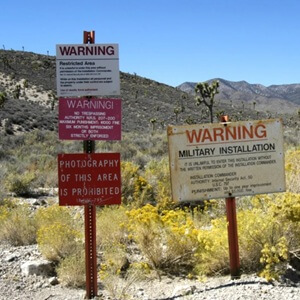
Setting aside the extraterrestrial hype, Area 51 has long served as a hub for advanced weapons research and experimental aircraft development. The site sits within the Nevada Test and Training Range, about 83 miles northwest of Las Vegas. It was established in 1955 under the direction of the Central Intelligence Agency as part of Project AQUATONE, which ultimately produced the Lockheed U-2 a key innovation of the Cold War.
In the years that followed, the facility supported other classified programs, including the development of the Lockheed A-12, the F-117 Nighthawk, and the Lockheed D-21. Much of Area 51’s reputation as a UFO hotspot can be traced to these test flights, as their unusual speed and maneuverability often baffled unsuspecting observers.
Area 51 also borders Yucca Flat, a region heavily used by the U.S. military for nuclear weapons testing. While early tests were conducted above ground, underground detonations eventually became the preferred method due to their reduced radioactive fallout. In 1951, engineers carried out one of the first such tests “Buster-Jangle Uncle,” a 1.2-kiloton device detonated 17 feet below the surface. Amid escalating Cold War tensions, the Limited Test Ban Treaty was signed by the U.S., U.K., and U.S.S.R. to ban above-ground nuclear testing. The deepest underground nuclear test conducted by the U.S. occurred in 1971 beneath Amchitka, Alaska, at a depth of roughly 6,000 feet.
The United States carried out its last nuclear test in 1992, and the Comprehensive Nuclear Test Ban Treaty effectively brought an end to most officially sanctioned weapons testing among major powers. Since then, only a small number of confirmed nuclear detonations about 16 have been conducted by non-signatory countries, including India, Pakistan, and North Korea. Even so, nuclear armed states overall have significantly scaled back their stockpiles.
Donald Trump has repeatedly signaled interest in resuming underground nuclear testing, and the last remaining arms control agreement between the United States and Russia New START Treaty expired in February 2026. Even so, turning that idea into reality would be far from simple. From a logistical standpoint, reversing nearly four decades of global precedent would likely require at least three years of preparation at the Nevada Test Site, and Trump’s most recent public remarks on the issue came in October 2025.
There’s also the Comprehensive Nuclear Test Ban Treaty Organization (CTBTO) to consider. Established alongside the test ban treaty, the organization operates a highly sensitive global monitoring network designed to detect nuclear explosions. According to its executive director, Robert Floyd, the system can identify blasts with a yield of roughly 500 tons of TNT or greater about three percent of the energy released in the Atomic bombing of Hiroshima.
Although underground tests are more difficult to detect than those conducted above ground, they are not invisible. Research indicates that modern seismic detection methods can identify even relatively small buried explosions down to about 1.7 tons with accuracy rates approaching 97 percent.
“It’s almost certainly not nukes,” said Martin Pfeiffer, a semiotic anthropologist and nuclear weapons researcher, in comments to Popular Science. “Nuclear explosions produce a fairly distinctive seismic signature.” He also noted that U.S. underground tests have typically been conducted at relatively shallow depths, making this scenario even less likely.
So while the recent activity may sound dramatic, the chances that the United States secretly detonated more than a dozen nuclear devices beneath Area 51 this week are extremely slim. As for extraterrestrial explanations those remain firmly in the realm of speculation.”

Zane H
now thats really interesting.