
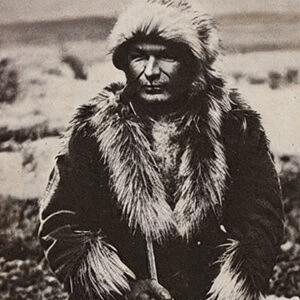
As written by Peter Byrne, “According to Indigenous accounts, Vancouver Island an immense landmass of 12,408 square miles off the west coast of British Columbia was once home to a significant population of Bigfoot. The Indigenous peoples of the island were aware of these beings, feared them, and respected them, yet generally believed they were not aggressive.
One member of the Nootka (Nuu-chah-nulth) people, living at Nootka in 1928, later claimed he had been taken by them and held captive for a period of time.
This account was related to me by Father Anthony Terhaar of Mount Angel Abbey in Oregon. Father Anthony, a well-known and deeply respected missionary priest, traveled extensively along the west coast of Vancouver Island for many years. At the time of the incident, he was stationed at Nootka and personally knew the man at the center of the story: Muchalat Harry.
Muchalat Harry was a trapper and something of an exception among his people. Father Anthony described him as tough, fearless, and powerfully built. Unlike most coastal Indigenous people of that era who regarded the deep inland forests with caution and rarely entered them alone Muchalat Harry traveled the wilderness by himself without fear. The forests, after all, were believed to be the domain of the Bigfoot.
In late autumn, Muchalat Harry set out on what was meant to be a long trapping expedition. Carrying his traps and camping gear, he paddled his canoe from Nootka to the mouth of the Conuma River at the head of Tlupana Inlet. There he cached the canoe and proceeded upstream on foot. About twelve miles inland, he built a lean-to and established a base camp, from which he began setting his trap line.
One night, while asleep in his blankets and wearing only his woolen underwear, Muchalat Harry was suddenly seized by a large male Bigfoot. The creature lifted him effortlessly and carried him into the hills, traveling perhaps two or three miles. When daylight came, Muchalat Harry realized he was in a crude camp beneath a high rock overhang. Surrounding him were approximately twenty Bigfoot males in front, females behind them, and the young at the rear.
At first, they merely stared.
His fear turned to terror when he noticed numerous bones scattered around the site. Convinced he was to be killed and eaten, he pressed his back against the rock wall and remained completely still. The Bigfoot, however, did not harm him. Occasionally one approached and touched him curiously. When they discovered that his “skin” was loose his woolen underwear several gently tugged at it, apparently puzzled.
Cold, hungry, and terrified, Muchalat Harry waited for an opportunity to escape. Late in the afternoon, as most of the Bigfoot left the camp likely to gather food he sprang to his feet and ran. He fled downhill toward where he believed the river lay and soon reached his campsite. In blind panic he did not stop, but continued running the full twelve miles downstream to the place where his canoe was hidden.
Father Anthony later described Muchalat Harry’s return to Nootka. It was around three in the morning. The village was asleep when wild cries echoed across the inlet. Lights appeared, and people rushed to the shore. There they found Muchalat Harry collapsed in his canoe, nearly frozen and exhausted. He was barefoot, clad only in torn, soaked underwear, having paddled forty-five miles through the winter night from the mouth of the Conuma River.
He was carried ashore nearly lifeless. It took three weeks of constant care to restore him to physical and mental health. Father Anthony, who personally nursed him, later told me that during those three weeks Muchalat Harry’s hair turned completely white.
The story of the abduction emerged slowly. At first, Muchalat Harry would speak to no one. Eventually he confided in Father Anthony, and later in others. When he had fully recovered, he was asked when he intended to return to retrieve his belongings his camp equipment, trap line, cookware, and especially his rifle. In 1928, such items represented great value. Yet Muchalat Harry never returned. He not only abandoned his possessions, but never again entered the forest for the rest of his life. According to Father Anthony, he remained at Nootka permanently, unwilling to risk another encounter.
In late 1972, I visited Vancouver Island while conducting a routine investigation. From Nanaimo I drove west, stopping in Gold River to obtain maps and directions from the Royal Canadian Mounted Police. By then, a logging road extended to the mouth of the Conuma River. One quiet Sunday morning, with logging traffic absent, I drove in and made camp.
For several days I explored the riverbed and surrounding forest, attempting to estimate where Muchalat Harry’s lean-to might once have stood. I identified a promising site twelve miles upstream near a series of high bluffs. The salmon were running, and throughout the night I heard them splashing through the shallows. In the mornings, black bears moved along the river, feeding on stranded fish. I counted six bears over several days.
The country was wild and largely deserted. The mouth of the Conuma, where it met the salt waters of the inlet, was among the most beautiful places I have ever seen. Though some forest near the river had been logged, the work had moved on, and the area was quiet once more.
Mornings began with mist rising from the river, giving way to crisp autumn days. Evenings were cool and damp, and nights were bright with starlight. I found no sign of Bigfoot, nor any trace of Muchalat Harry’s camp unsurprising after more than forty years.
Yet the river and forest themselves remained unchanged. The salmon, the cold clear water, the moss-covered banks, the shallow spawning pools, the river birds, the slow-moving bears, and the deep silent inlet were all as they must have been decades earlier, when Muchalat Harry cached his canoe and walked alone into the wilderness.

Lisa B
Cool story! Thanks Wes!