
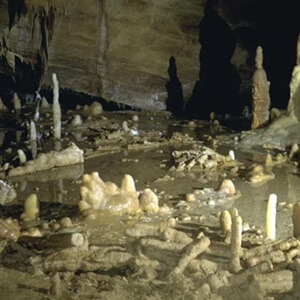
Deep inside Bruniquel Cave, researchers discovered large circular structures constructed from broken stalagmites. They are located roughly 336 meters (1,100 feet) from the cave entrance, far beyond the zone that would have received natural daylight.
The structures were dated to approximately 176,500 years ago, with an uncertainty of about ±2,100 years. Uranium-series dating was performed on mineral growth associated with the structures and on other materials, providing multiple lines of dating evidence.
There are six structures:
Two large ring-shaped structures
Four piles/arrangements of stalagmite fragments
More than 400 pieces of stalagmite were used.
The largest ring measures approximately 6.7 × 4.5 meters.
Some pieces were deliberately broken to relatively similar lengths and carefully arranged.
Evidence of fire or heating was found on numerous pieces.
Burned bone was also discovered nearby.
What’s particularly impressive is that these weren’t simply rocks lying naturally on the cave floor. The researchers concluded that the geometry, arrangement, and evidence of fire demonstrated deliberate human construction.
At approximately 176,500 years ago, modern humans (Homo sapiens) were not yet established in Europe. The researchers therefore attributed the structures to early Neanderthals, based on the archaeological context and the known human occupation of the region at that time.
The discovery dramatically changed perceptions of Neanderthals.
They weren’t simply wandering hunters living around campfires. Whoever constructed these rings had to:
Enter an extremely deep cave.
Travel hundreds of meters underground.
Have a source of artificial light.
Break and transport hundreds of heavy stalagmite pieces.
Select and arrange the pieces deliberately.
Construct organized circular structures.
Maintain fires deep underground.
That implies planning, cooperation and considerable knowledge of the cave environment.


Leave a Reply
You must be logged in to post a comment.