
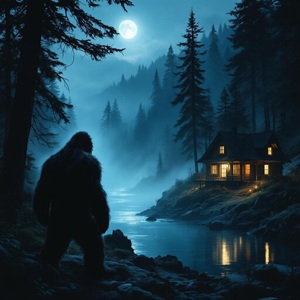
In the early days of September 1941, the Chapman family lived quietly along the banks of Ruby Creek, near the Fraser River in British Columbia. George Chapman worked the railroad, and his wife Jeannie tended to their home and children. Life was simple, peaceful until one evening when that peace would shatter forever.
It began with a terrified scream. One of the Chapman children, no older than nine, came running into the house, eyes wide, gasping, “Mom! Mom! There’s a cow in the woods!” But Jeannie knew in her gut that something was wrong. Mrs. Chapman stepped outside, concerned because her son seemed unusually unsettled. At first, she thought she saw a very large bear moving among the bushes along the edge of the field beyond the railway tracks.
She called to her two children, who came running immediately. As the creature moved onto the tracks, her horror grew as it was no bear. It was a gigantic, human-shaped being covered in hair rather than fur. The hair was pale yellow-brown, about four inches long all over. To illustrate the color, Mrs. Chapman pointed to a lightly varnished sheet of plywood in the room, noting its brown hue matched the creature’s hair.
The creature began moving directly toward the house, and Mrs. Chapman recalled that she had, in her words, “far too much time to look at it.” She stood her ground outside while instructing her eldest son to fetch a blanket and gather the other children. The kids were nearly panicked, and it took two or three minutes to retrieve the blanket, during which time the creature advanced to the near corner of the field, roughly 100 feet away.
Once she had the blanket, Mrs. Chapman held it to shield the children from view and backed out rapidly through the field, down to the riverbank out of sight. From there, she ran with the children downstream toward the village, keeping them hidden and safe.
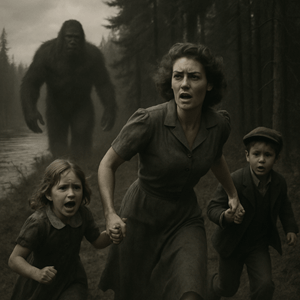
Mrs. Chapman later said, it was a massive upright figure. It moved like a man, but its entire body was draped in long, pale yellow-brown hair nearly five inches in length. Its arms swung with heavy, effortless power, and each step landed with deliberate weight. Whatever it was, it was far larger than any human and it was walking straight toward their home.
Mrs. Chapman estimated the creature to be about seven and a half feet tall, judging by the fence posts scattered around the field. Its head was small, perched on a neck so short and thick that it looked as though it had none at all. The creature’s frame was human in outline but massively built, with an exceptionally broad chest and arms that hung longer than any man’s. Its feet were hidden in the tall grass, but its shoulders were vast. It had no visible breasts, which led her to assume it was male, though the long hair covering its lower body concealed any further detail. One thing she was absolutely certain about, the exposed skin on its face and hands was much darker than its hair almost coal black.
George Chapman finished his shift on the railroad and headed home shortly before six that evening, taking a back route that bypassed the village. Because of that, he had no idea what had unfolded earlier in the day.
The moment he reached the property, he noticed something was wrong. The woodshed door had been smashed inward, and enormous, human-shaped footprints covered the ground. Alarm shot through him. Like everyone raised in the area, George had grown up hearing stories about the “big wild men of the mountains,” long before he ever heard the term Sasquatch which, in fact, he wouldn’t hear until after this incident.
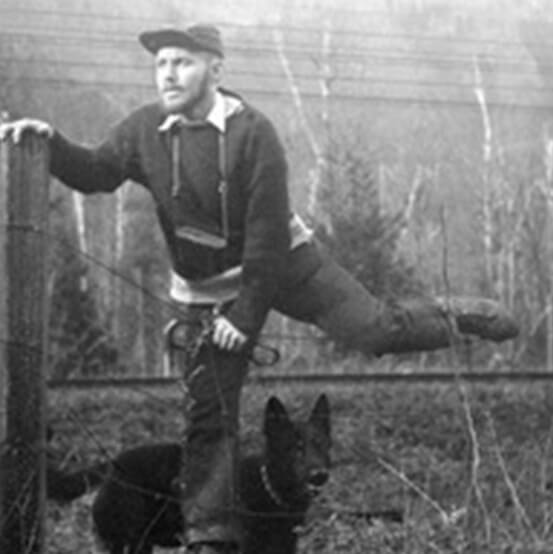
Calling out for his family, he rushed through the house. Finding no one inside, he spotted his wife’s and children’s footprints leading toward the river. He followed them until he reached the sandy bank, where he saw their tracks continuing downstream thankfully without any giant prints trailing behind.
Relieved but still shaken, George turned back only to find something worse. Upstream, huge tracks stamped the mud, coming down from the potato patch that sat between the house and the river. The creature had milled around near the water before heading back through the field and into the thick brush at the base of the mountains, where the tracks finally vanished.
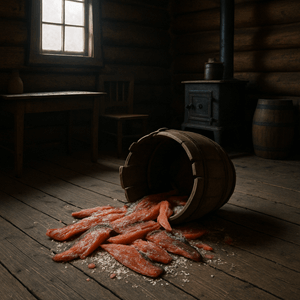
Back at the house, with the comfort of knowing his family had made their way toward the village, George inspected the damaged woodshed. Even eighteen years later, he still spoke with disbelief about what he found. A 55-gallon fish tub, split open, lifted and smashed without any tool marks. He couldn’t imagine any living person, even a massive, barrel-chested man, handling it that way. He confirmed the creature’s height, too, after spotting long brown hairs stuck in the slabwood lintel of the doorway well above his own head.
George then hurried to the village, where he found his wife and children in a state of exhausted collapse. After gathering them up, he asked his father-in-law and two others to return with him to the cabin, ensuring someone would be there to protect his family whenever he was away working on the railroad.
When the initial terror faded, the Chapmans surveyed the damage. Around their property were giant footprints, some nearly 17 inches long. Long strands of hair clung to the wood of their shed, as if the creature had brushed against it while investigating their home. From the forest came a sound unlike anything they had heard before a strange, gurgling whistle that seemed almost deliberate, almost communicative.
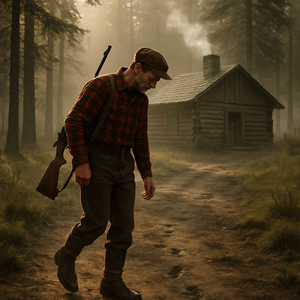
For several nights, the creature returned. Tracks appeared, footprints pressed deep into the soil. The family felt watched, followed. Fear consumed them, until finally, they made the heartbreaking decision to abandon their home, leaving behind the life they had built along the creek.
In the years that followed, tragedy seemed to shadow the Chapmans. Their children would die young, two by drowning, one by illness. George and Jeannie themselves later perished in a boating accident on the Fraser River. Some say it was cruel misfortune. Others whisper that the shadow of Ruby Creek had marked them that September night.
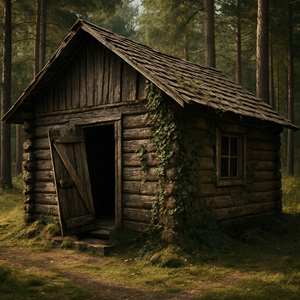
Even today, the Ruby Creek incident remains one of the most chilling Bigfoot encounters ever recorded. A creature glimpsed, footprints left in soft earth, hair caught on wood, and a haunting whistle echoing through the trees.
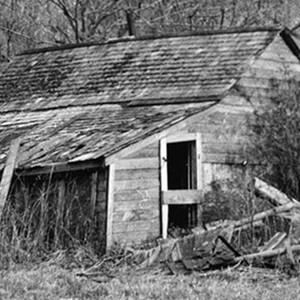
The original Chapman cabin at Ruby Creek did not endure; left vacant over the years, it eventually fell into ruin. In the mid-1990s, a new house was constructed on the property by Deborah Schneider, a relative of Mrs. Chapman.
This newer home stands in a different location on the lot specifically, on the opposite side of the “twin fir trees” that had marked the site during the 1941 incident.

Chad W
Thanks! This is a seminal story in sasquatch history. I can only imagine how terrifying it must’ve been for the family.
Charles R
Indeed Chad W. One of the first I read a long time ago. It was after the Salmon. Sara Brown has a youtube account of a Washington State Native Tribe that had a good size building for smoking salmon for winter food. It was broken into by a Bigfoot(s) and damaged the building. So they started to put salmon out away from this building for the Bigfoot(s) and repaired the smokehouse.