

During the Vietnam War, American troops began reporting encounters with strange, human‑like creatures deep in the jungles. These beings became known as “Rock Apes,” “Batutut,” “Ujit,” or “Nguoi Rung” (the Vietnamese term meaning “Forest People”).
While officially considered folklore, the sheer number of eyewitness accounts has made the story one of the most enduring mysteries of the war.
Long before American soldiers arrived, the indigenous people of Vietnam, Laos, and Cambodia had ancient stories of hairy, upright creatures living in the remote mountains and jungles. These beings were said to resemble apes but behaved more like primitive humans.
Many locals considered them real animals not myths. Between 1965 and 1972, hundreds of U.S. Marines and Army personnel reported seeing strange creatures in the highlands.
The Battle of Dong Den (1968)
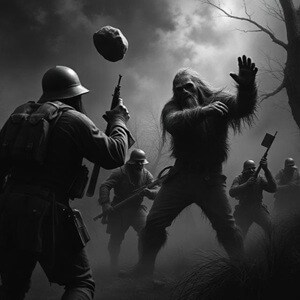
American Marines and Army units were stationed on a ridge in the Annamite Mountains, tasked with holding the area against Viet Cong and North Vietnamese forces. The dense jungle, rocky terrain, and near-constant rain made movement difficult and visibility poor.
It was during one of these tense nights that a unit of 6th Marines, 3rd Battalion reported something unusual.
Soldiers were in their defensive positions, listening to the sounds of the jungle, when they heard unusual movement. Branches snapping, rocks shifting, and strange, guttural noises came from the forest just outside their perimeter.
At first, they assumed it was the enemy. But as the figures emerged from the shadows, it became clear that they were not human.
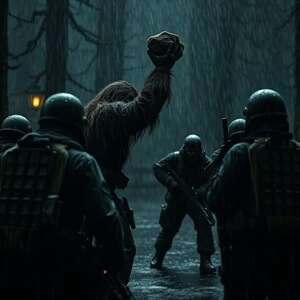
The Marines reported that several hair-covered, upright creatures appeared just outside the tree line. They began screeching, barking, and hurling rocks at the Marines. Thinking they were under attack, the Marines opened fire. The creatures did not collapse like humans, some were hit multiple times and kept moving. The fight lasted nearly 45 minutes. When daylight came, no bodies were found, only blood trails and footprints.
Multiple Marines filed reports
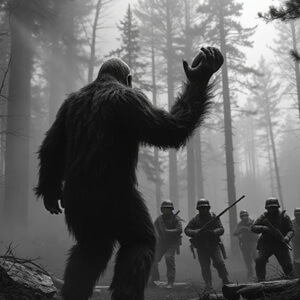
The Marines described the creatures as 5-7 feet tall and covered in reddish-brown or dark hair. They were muscular and upright like humans, they had flat noses and large eyes, giving a primitive yet intelligent appearance. The Marines also said they had long arms, longer than a human.
Several Marines stated, “There were small groups leaping between rocks and strange vocalizations that didn’t match monkeys, gibbons, or known wildlife. Objects being thrown from the forest without visible assailants.”
These creatures began hurling rocks at the Marines, which is how the nickname “Rock Apes” came about.
Hill 868 – “Monkey Mountain”
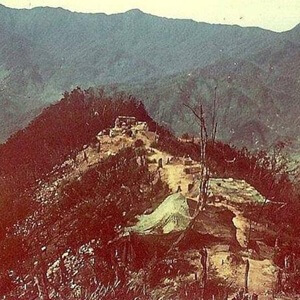
During the Vietnam War, the highlands of central Vietnam were a hotspot for U.S. military operations. One area, known as Hill 868, earned the nickname “Monkey Mountain” not for actual monkeys, but because of repeated reports of mysterious creatures called Rock Apes by Marines stationed there.
These creatures were described as bipedal, hair-covered, and extremely strong, and Hill 868 became legendary among soldiers because of how often they appeared.
Cam Lo Valley
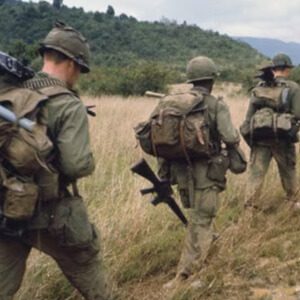
The Cam Lo Valley, in Quang Tri Province near the DMZ, was a heavily patrolled area during the Vietnam War. Soldiers frequently conducted long-range reconnaissance and small patrols through dense jungle, rugged hills, and narrow river valleys.
It was during these patrols that Rock Ape sightings began to appear in official and anecdotal reports. One report comes from a patrol of U.S. infantry, they were moving quietly along a narrow jungle trail, scanning for Viet Cong movement. Suddenly, one soldier spotted a massive, human-like figure ahead of the group about 7 feet tall and covered in reddish-brown hair. The creature took off, moving with incredible speed and agility. Soldiers reported “The creature was leaping between boulders along the riverbank with ease, faster and more fluid than any human soldier could manage in that terrain.
Soldiers also reported here vocalizations, “a mix of whoops, growls, and chittering sounds.”
Laotian Border
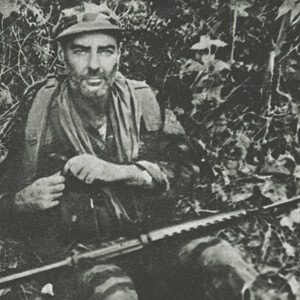
A Green Beret reported “We’d been moving quietly through a narrow valley, following a stream that snaked between sheer cliffs and dense bamboo. It was early evening. The light was fading, but we could still make out shapes in the underbrush.
At first, we thought we’d stumbled on local villagers. But as we got closer, shapes started moving differently than humans should. They were upright, bipedal, and covered in thick reddish-brown hair.
Then we realized there were more than one. Not just one creature. Multiple. Dozens. And what’s worse, they weren’t just scattered. They were organized, moving as a family smaller juveniles following larger adults. The group moved fluidly, almost silently, through the forest.
I froze. My instincts screamed to open fire, but every experienced soldier in the group knew you don’t start shooting at something you don’t understand.
We watched as, a large male led the group, towering over us at six or seven feet tall, muscular, with long arms that could probably crush a tree branch. Several females moved to either side, keeping watch. Juveniles clung to branches, learning to leap and navigate the rocky terrain.
Rocks and small branches were thrown not aggressively, but as a form of communication, like a warning to stay back.
What struck me most was their intelligence. These weren’t animals acting on instinct. They seemed aware of our presence, studying us, almost curious. They didn’t rush us. They didn’t run. They simply watched. We stayed still for nearly an hour, barely breathing, hidden behind fallen logs and dense foliage. One of our men, unable to contain his curiosity, whispered, “Do you see that?”
I turned slightly and caught a juvenile peeking around a tree, its glowing eyes catching the last light of the sunset. Another adult had stepped behind a boulder, only its massive shoulders visible. When we tried to get a better view, the creatures moved in perfect synchronization, vanishing and reappearing in different positions, like shadows dancing between trees.
No one spoke. We all knew that these were not ordinary primates. They were something else.”
Many Vietnamese villagers believe the Rock Apes are a surviving population of Batutut, a legendary forest-dwelling humanoid. Even after the war, sightings continued. The Vietnamese government has even conducted limited expeditions to search for the Nguoi Rung, though nothing conclusive has ever been found.
To this day, the Rock Apes remain one of the most intriguing wartime cryptid stories a creature seen by dozens of battle‑hardened men who swore they weren’t imagining it.

Charles R
They may be a shorter version of the Sasquatch, due maybe to tropical termperatures. Across over 10,000 readings and interviews, I have not come across someone who has seen so many in a clan type group moving together here in North America. Maybe 10 years ago while outside of the Ohio DMV in Greenville, I got talking with a Vietnam Vet, who was in intelligence during this war. Me being me, I asked if he or anyone else he knew has seen these rock apes. Right away he stated he had not, however his brother had in the Central Highlands of Vietnam.