Yes this is true, and it’s actually one of the coolest geology facts about Mount Everest.
The wind was already howling when the climbers stepped onto the upper slopes of Mount Everest. At that height, everything felt impossible breathing, walking, even thinking clearly. The world was nothing but ice, rock, and sky.
Jake, one of the climbers, paused to steady himself. His boot scraped against a patch of exposed rock jutting through the snow. That wasn’t unusual Everest is full of broken stone but something about this piece caught his eye. It looked… patterned.
He crouched down, brushing away frost with his gloved hand. At first, he thought it was just a strange ripple in the rock. But as more ice flaked away, the shape became clearer: a curved, ridged imprint. Almost like…
“No way,” he muttered into his oxygen mask.
His teammate Maya trudged over. “What is it? We don’t have time to..”
She stopped mid-sentence.
There, etched into the gray limestone, was the unmistakable spiral of a shell.
Up here. Near the top of the world.
For a moment, neither of them spoke. The wind roared around them, but the discovery made everything feel strangely quiet.
“A seashell?” Maya finally said, her voice half disbelief, half awe. “That’s impossible.”
Jake shook his head slowly. “Not impossible. Just… old.”

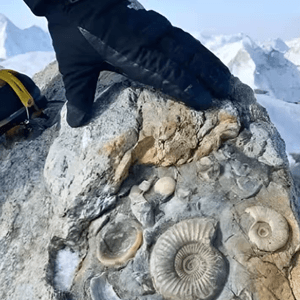
He remembered something from a documentary something about mountains rising, oceans vanishing. This wasn’t just a rock. It was a fossil. The remains of a creature that had once lived in a warm, shallow sea.
Right where they were standing.
Long before ice and altitude and climbing gear, this place had been underwater. Tiny marine animals had lived and died, their shells settling into soft sediment. Over time, layer upon layer buried them, turning them into stone.
Then the Earth itself had shifted.

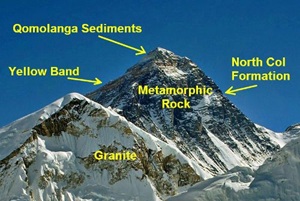
When the land that is now India slammed into Asia, the seafloor didn’t disappear it crumpled and rose, slowly but relentlessly, pushing those ancient ocean beds higher and higher until they became the Himalayas.
And now, here they were two climbers gasping for air standing on what had once been the bottom of an ocean.
Maya reached out and gently traced the fossil with her glove. “So this… was alive,” she said. “In the sea.”
“Yeah,” Jake replied. “And somehow it ended up closer to the stars than the ocean ever was.”
They didn’t take the rock. It felt wrong to carry it away. Instead, they left it where it had rested for ages—frozen into the roof of the world, a quiet reminder that even the tallest mountain on Earth had once been beneath the waves.

As they continued their climb, the wind picked up again, erasing their footprints almost instantly.
But the thought stayed with them:
At the top of the world, they had found the ocean.
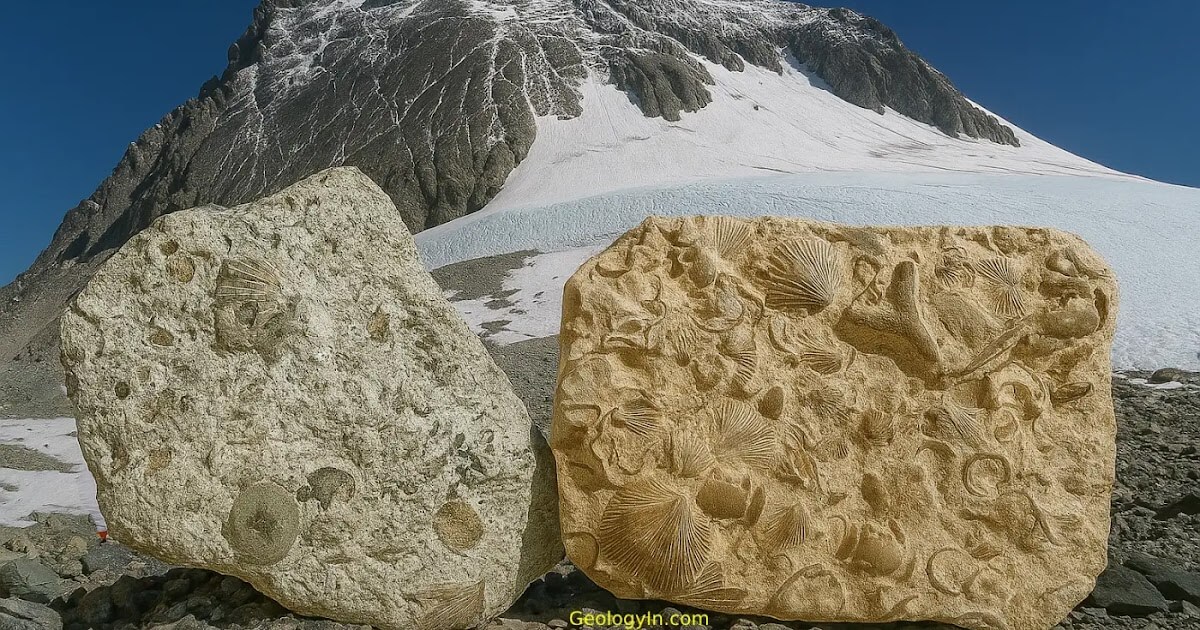
Climbers and geologists have reported marine fossils, including shell-like organisms, high on Everest even near 8,000 meters (26,000+ ft). These fossils aren’t modern seashells lying around they’re ancient, fossilized remains of sea creatures such as:
- brachiopods (shell-like animals)
- trilobites
- crinoids
Because Everest used to be under the ocean.