On the night of September 19, 1976, Tehran was settling into sleep when the phone lines at Mehrabad Air Force Base began lighting up.
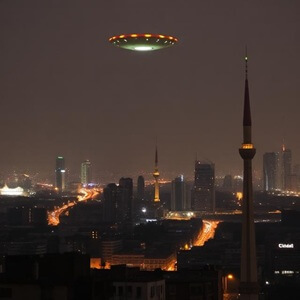
Civilians across the city were calling in, all reporting the same thing: a brilliant object hanging in the sky, far brighter than any star, pulsing with colors white, blue, red changing rhythmically, almost deliberately.
At first, duty officers assumed it was an astronomical object. But when radar operators confirmed a solid return, the mood changed. Whatever was out there wasn’t just being seen it was being tracked.
Shortly after midnight, the Imperial Iranian Air Force scrambled an F-4 Phantom II interceptor. The jet roared into the night, climbing fast toward the object.
As the pilot closed the distance, something extraordinary happened.
At roughly 25 nautical miles, his instrument panel went dark. Communications cut out. Radar failed. Navigation systems died. The aircraft was suddenly blind and mute.
The pilot broke off the intercept and turned back toward base.
The moment he did, everything came back online as if nothing had ever been wrong.
Command decided to try again.
A second F-4 Phantom was launched, this time piloted by a highly experienced crew. They climbed toward the glowing object, now visibly maneuvering in ways no conventional aircraft could hovering, then accelerating without sound.
As the jet approached, the crew saw something even stranger.
A smaller, intensely bright object detached from the main craft and raced directly toward them.
Believing they were under threat, the pilot attempted to fire an AIM-9 missile.
The instant he tried to arm the weapon, the entire weapons control system failed..

No firing. No lock. Nothing.
Once again, communications dropped. Instruments flickered. The smaller object passed close by the jet, then abruptly stopped hovering before returning to the larger craft.
Another luminous object soon separated, descending rapidly toward the ground. Ground radar tracked it all the way down until it appeared to land outside Tehran. Search teams later found no debris, no impact site nothing.
As dawn approached, the primary object climbed higher and higher, until it faded into space.
The pilots returned shaken but composed. Their aircraft showed no mechanical faults. Every system tested normal. No explanation fit what had happened.
What made the incident impossible to ignore was what followed.
A classified report was forwarded to the U.S. Defense Intelligence Agency, then circulated to the White House, Joint Chiefs of Staff, CIA, and NSA. The DIA described the case as a “classic UFO incident”, citing multiple radar confirmations, visual sightings, and electromagnetic interference affecting military aircraft.
No definitive explanation was ever given.
To this day, the 1976 Tehran UFO Incident remains one of the most compelling military encounters on record because it wasn’t just a sighting.
It was a controlled response, involving trained pilots, advanced aircraft, radar tracking, and system failures that only occurred when humans got too close.
And whatever was over Tehran that night…it clearly knew they were there.