
On August 16, 2026, two pilots flying a private charter jet over Ohio encountered something neither could readily explain. Cruising at more than 41,000 feet, the pilots spotted an unusual silver object that appeared to be suspended in the sky, almost motionless, as their aircraft approached.
What made the encounter particularly interesting was that the object appeared to have no wings, engines, visible propulsion system, or other recognizable aircraft features. It was described as a perfectly uniform, metallic, pill-shaped object that reflected sunlight like polished chrome.
The pilots contacted air traffic control to ask whether any aircraft or weather balloons were operating in the area. The response was surprising: controllers could not identify anything on radar that corresponded to what the crew was seeing.
The encounter was later investigated by NUFORC (National UFO Reporting Center), with investigator Ben Hansen interviewing the pilot and obtaining additional information about the flight, photographs, and air traffic control communications.
Here is the account of what happened.

The Encounter Begins Above Ohio
The sighting occurred at approximately 8:01 p.m. Eastern Time, near Tiffin, Ohio. The two pilots were operating a private charter aircraft, but they were flying without passengers.
The aircraft had reached its cruising altitude of approximately 41,000 feet (Flight Level 410). Ahead of them was a significant thunderstorm system, with cloud formations reportedly reaching altitudes between 53,000 and 55,000 feet.
Rather than fly directly into the storm, the pilots decided to look for a gap between the clouds that would allow them to pass through safely.
It was during this approach that the captain noticed something unusual ahead of the aircraft.
At first, he estimated the object was approximately five miles away. During his later interview with NUFORC investigator Ben Hansen, however, he reconsidered the distance and believed it may have been closer to two or three miles when he first noticed it.
The object appeared slightly above their altitude, at approximately 43,000 feet.
What caught the pilot’s attention was its unusual appearance. It seemed almost stationary in the sky, or as though it were slowing down as the aircraft approached.
The captain was familiar with seeing other aircraft approaching from the opposite direction. He explained that approaching aircraft can sometimes appear nearly motionless at a distance before their movement becomes more apparent as the distance closes.
Based on his experience, he believed this object was moving under its own propulsion.
A Perfectly Smooth, Metallic Object
As the aircraft drew closer, the pilots were able to get a better look at the object.
The captain described it as cylindrical or pill-shaped, with a completely uniform appearance. It was oriented vertically, almost as if someone had placed a giant pill upright in the sky.
There were no visible wings, stabilizers, engines, control surfaces, or other recognizable flight components. The object also appeared to have no seams, wrinkles, creases, or irregularities.
In his report, the pilot described its appearance:
“The surface was silver and highly reflective, like pure polished metal.”
Initially, the captain considered whether they might be looking at a weather balloon. However, the closer they got, the less convinced he became.
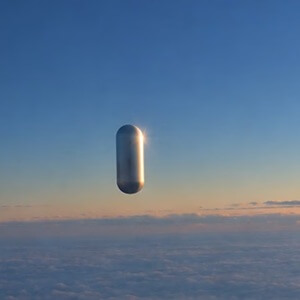
He explained that the object did not appear to taper at either end. It maintained the same general width from top to bottom, unlike what he would normally expect from an inflated balloon. The sunlight was still bright, and the object appeared to reflect the sun intensely. The pilot believed the brightness was caused by sunlight reflecting off its surface rather than the object producing its own illumination.
The crew estimated that the object was approximately three-quarters the length of their aircraft. Their jet was just over 40 feet long, meaning the object could have been roughly 30 feet in height. It was an unusual sight, especially considering the altitude at which it was traveling.
The Pilots Contact Cleveland Center
Realizing they were looking at something they could not identify, the captain contacted Cleveland Center, the air traffic control facility responsible for monitoring aircraft in that portion of the sky.
He asked whether there were any weather balloons or other aircraft operating in the vicinity.
The pilots had already checked their aircraft’s Traffic Collision Avoidance System (TCAS), which is designed to alert flight crews to nearby aircraft that could present a collision threat.
Nothing appeared.
The captain also checked his ForeFlight application, which receives Automatic Dependent Surveillance-Broadcast (ADS-B) information from aircraft transmitting their positions.
Again, nothing appeared to account for the object.
The response from air traffic control was equally puzzling. According to the NUFORC investigation, controllers told the pilots there were no identified aircraft or unidentified objects appearing on radar in the location where they had spotted the object.
The captain estimated that approximately 45 seconds to a minute had passed between initially seeing the object and contacting air traffic control.
The crew continued watching it as it passed off the left side of their aircraft.
At its closest point, the object was estimated to be approximately five nautical miles away, although the pilot’s later recollections suggested the distance could have been somewhat different.
The object appeared to be traveling northwest while the jet was heading southeast. It seemed to maintain its altitude and pass on a roughly parallel track.
Eventually, it disappeared behind the aircraft and out of sight.
The entire encounter lasted approximately two minutes.
The Photograph Taken by the Pilot
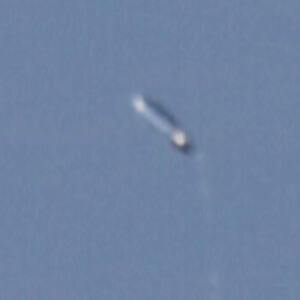
One of the most interesting aspects of this case is that the captain managed to take a photograph of the object.
However, he explained that he only thought to grab his iPhone after the object had already passed the aircraft.
By the time he captured the image, the object was approximately seven miles behind them.
The captain emphasized that his description of its shape, size, and reflective metallic surface came from observing it much closer during the earlier portion of the encounter.
The photograph was taken using Apple’s Live Photo feature, and the pilot provided it to NUFORC investigator Ben Hansen along with screenshots from his ForeFlight application.
He also supplied photographs of the thunderstorm clouds the aircraft encountered during the flight.
Could It Have Been a Weather Balloon?
One possible explanation considered by the captain was a weather balloon.
However, several details made him question that possibility.
First, the object appeared to have a uniform cylindrical shape, without the expected narrowing or tapering at either end.
Second, the pilot believed it may have emerged directly from the wall of thunderstorm clouds ahead of them.
This detail became particularly important when the captain described what happened after their aircraft entered the storm.
The jet experienced engine icing and moderate turbulence while passing through the clouds.
The captain questioned whether a balloon could have survived the same conditions and remained intact.
He also believed the object’s movement suggested it was under its own propulsion rather than simply drifting with the wind.
That said, the balloon explanation has not been definitively eliminated. An object can be difficult to identify from a distance, and the available photograph was taken after the closest portion of the encounter.
NUFORC Investigator Ben Hansen Takes a Closer Look
Following the initial report, NUFORC investigator Ben Hansen contacted the captain for a more detailed interview.
Hansen spoke with the witness by telephone and obtained additional information about the flight, the object’s appearance, its estimated size, and the circumstances surrounding the encounter.
The captain provided several supporting materials, including:
-
A photograph of the object taken with his iPhone.
-
Screenshots from his ForeFlight application.
-
Photographs of the thunderstorm clouds.
-
Additional details about the aircraft’s altitude, speed, and flight path.
The investigator also wanted to determine whether the object could have been an aircraft or some other known object operating in the area.
The initial investigation found no corresponding aircraft on the plane’s TCAS or ADS-B tracking information.
Hansen subsequently submitted a Freedom of Information Act (FOIA) request to the Federal Aviation Administration to obtain radar information and the radio communications between the pilots and Cleveland Center.
The resulting investigation included FAA radar data and recordings of the air traffic control communications.
According to NUFORC, the radar information did not reveal a corresponding object.
The investigation also found no database matches for planned balloon launches in the area.
Importantly, the absence of a radar return does not establish that the object was extraordinary. Not every object is detectable by every radar system, and some balloons and other objects may not transmit identifying signals.
Nevertheless, the lack of an identifiable aircraft or corresponding radar target left the sighting unexplained.
An Interesting Exchange With Air Traffic Control
One additional detail emerged from the investigation when the radio communications were obtained.
During the exchange, the air traffic controller made a joking remark about the pilots submitting a report to NUFORC, telling them:
“Make sure you include what color the alien was.”
Although the comment may have been intended humorously, NUFORC investigator Hansen pointed out that this kind of reaction illustrates a problem with UFO reporting among professional pilots.
Pilots may be reluctant to report unusual sightings because they fear ridicule or concerns about how such reports could affect their professional reputations.
NUFORC argued that unidentified objects near commercial and private aircraft should be treated as potential aviation safety concerns, regardless of what they eventually turn out to be.
How Big Was the Object?
One of the more intriguing details is the estimated size.
The aircraft was just over 40 feet long, and the captain estimated the object was approximately three-quarters of that length.
That would put the object’s estimated height at around 30 feet.
It reportedly maintained a consistent cylindrical shape, with no obvious wings, tail, propulsion system, or other recognizable aircraft components.
It was also observed at approximately 43,000 feet, above the cruising altitude of the pilots’ aircraft.
Whether the object was some type of balloon, an unusual atmospheric object, or something else remains unknown.
What Happened to the Investigation?
As of the NUFORC investigation published October 26, 2026, the sighting remained unexplained.
The organization raised concerns about the lack of a more extensive government investigation, particularly because the object was reportedly operating in controlled airspace near an aircraft traveling at hundreds of miles per hour.
Even if the object ultimately proved to be a balloon, an unidentified object of that size and at that altitude could represent a serious aviation hazard.
A collision with a high-altitude balloon or other object could potentially damage an aircraft, particularly its engines.
NUFORC investigator Ben Hansen also noted that the FAA radar data and recorded communications provided valuable supporting information for the case.
However, there was no confirmed identification of the object.

Charles R
Classic Tic Tac like what Commander David Fravor witnessed in 2004 off San Diego. And have many pilots, both military and cmmercial.